EPISODE
61
Season 2, Episode 22: 12 Part Series - The Creative Process - File Organization
EPISODE LINKS.
SHOW NOTES.
McFarland Minutes Step 8: Organizing Data Stores and File Structures
Natalie McFarland introduces McFarland Minutes and its weekly Sunday episodes, then temporary host Ryan covers step eight of the 12-step creative process: organizing data stores and files. He explains that consistent file structure saves major time later for recaps, year reels, client revisions, and server migrations. Using a commercial shoot example, he recommends choosing an organizational approach (by location, day, or camera), ensuring it fits the company’s broader storage system, and standardizing folders for footage, assets, projects, audio, and photos. Ryan discusses batch labeling files so raw media can be identified at a glance, favoring date and client name, and advocates versioning exports and revisions (V1, V2, etc.) to avoid mistakes and repeated work. He highlights benefits for onboarding staff, retrieving project files, and efficiently deciding what to keep or move during storage changes.
00:00 Welcome to McFarland Minutes
00:33 Today’s Topic Data Organization
02:05 Planning Your Folder Structure
04:32 Naming and Batch Labeling
06:21 Project Files and Revisions
07:18 Why Standards Help Teams
09:33 Time Savings for Repeat Work
10:25 Storage Moves and Archiving
11:53 Wrap Up and Next Steps
ABOUT THIS EPISODE.
Mastering File Organization: A Creative’s Guide to Efficiency
Hey everyone, welcome to another edition of McFarland Minutes! I’m Natalie McFarland, founder and president of McFarland Productions, director at Off Your Rocker Films, and your host for this exciting journey into the creative processes behind the scenes. In this series, you can expect everything from deleted scenes, campaign reviews, and project highlights to marketing concepts and book reviews. We delve deep into the creative process at Off Your Rocker Films and explore invaluable lessons on mentorship, leadership, and the business aspects of creativity. Remember, we release our episodes every Sunday to give your week a productive start.
Today, we’re diving into an essential aspect of creativity that might not always seem thrilling but is undeniably crucial: **File Organization**. This is step eight in our twelve-step creative process.
The Importance of File Organization
Hi, I’m Ryan, your temporary host for today, stepping in to guide you through this vital, albeit underrated, part of the creative process. While it might not have the immediate allure of onsite production, proper file organization will save you countless hours and likely a few headaches in the future. It’s a timeless investment for a smooth workflow, whether you’re wrapping up a project or revisiting it years down the line.
Why should you care about file organization? It’s simple: you need to prepare your files effectively for consistent access and potential reuse. Imagine having to move all your storage from one server to another four years from now without knowing what’s what. Proper organization can prevent such logistical nightmares.
1. Categorization by Project Type:
– Consider the specifics of each project, like whether it involves multiple locations or days. Do you categorize by day, location, or camera? Every shoot might demand a different approach.
2. Integrating with Existing Systems:
– Ensure your new shoot fits into an existing organizational system, whether on a large server or a compact drive. Consistency is key, especially for new team members onboarding.
3. Universal File Structure:
– Aim to implement a system applicable to all folders, using consistent categories like footage, assets, projects, etc., making it easier to dump and retrieve content as needed.
Naming Conventions and Batch Labeling
Don’t underestimate the power of a good naming convention. Choose your batch labels carefully—they should offer easy insights into what your files contain, such as the date, client, location, and camera type. This makes file retrieval intuitive, fostering efficient teamwork and minimizing miscommunications.
Handling Projects and Revisions
Revision Control:
One effective approach is organizing projects based on stages of revisions. Using versioning systems (e.g., V1, V2, V3) can ensure clarity and prevent redoing past work. Having previous versions readily accessible supports both client requests and internal assessments.
Onboarding and Time-Saving Benefits
A standardized system significantly eases onboarding. With consistent file naming and an accessible structure, new staff members can easily get up to speed, avoiding the redundancy of creating multi-system chaos.
Further, maintaining this rigor ensures that past decisions aren’t questioned or redone unnecessarily—all of which contributes to saving time across projects and reducing stress.
Future-Proofing Your Organization
Whether you’re offloading files onto new drives or upgrading servers, knowing what you need and don’t need becomes easier with well-structured folders. Clear naming conventions help you swiftly prioritize which files to keep and optimize for ongoing projects.
By standardizing these practices, you cushion your organization against uncertainties, ensuring resilience and continued efficiency.
Thank you for joining us on this journey into the world of file organization. If you haven’t yet checked out our previous episodes, give them a listen for a fuller understanding of our creative process. Stay organized, stay efficient, and we’ll see you in our next edition. Bye for now!
IN THIS EPISODE.

Ryan Lee
Creative Content Manager, McFarland Productions
Starting as the Intern in 2023, Ryan is now the Post-Production Editor and has joined the team full time. His creativity and organization play a crucial role in quickly creating unique content all across the board, however with a core focus on video production. Ryan grew up in Gladstone, OR, where he spent time playing sports, on the water, and in the mountains. He attended Oregon State University where he got his Bachelors Degree in Digital Communication Arts. Although Oregon will always be his home, he spent previous years in Tennessee, and now lives in Connecticut. In his free time he enjoys cooking just as much as eating, and if you can do both outside, all is good in the world.
After spending time filming and editing countless events, sports, adventures and more, Ryan’s main action in the company is to organize, edit, and export content. Whether it’s 30 minutes and horizontal or 30 seconds and vertical, moving or still, he’ll take care of it.
ABOUT YOUR HOSTS.
NATALIE MCFARLAND

PRESIDENT, FOUNDER
MCFARLAND PRODUCTIONS
After freelancing her way through college, Natalie established McFarland Productions in 2014, which has continued to grow rapidly over the last few years. Her passion and focus have always remained the same; capturing, understanding, preserving and promoting Ranching, Farming, Western Lifestyle and AgriBusiness. She has always had a love for the western culture and even at a young age it was unmistakably clear she would someday find a career serving the industry.
Natalie grew up on a small ranch, rodeoed, showed horses in a variety of disciplines, showed livestock, and participated in 4H and Oregon High School Equestrian Teams. She has trained herding dogs and started colts, worked with sheep and cattle and has had the experience of racing to finish up a hayfield before a rainstorm hit. She understands the joys, sorrows, wins, losses and hard work of ranchers and farmers. That’s why McFarland Productions can produce authentic marketing campaigns for the businesses, organizations, events, and brands of the western and agriculture industry – it’s who she is.
With a passion for building community surrounding brands, Natalie focuses on building real connections between companies/brands and the people that make up their community. Telling the stories of your customers and making them apart of the brand’s story is her main focus. Creating real, human, meaningful connections and strengthening community within the western and agriculture industry through strategic marketing services.
SCOUT FOSTER
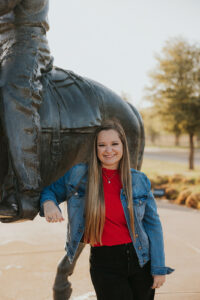
DIRECTOR OF STRATEGIC STORYTELLING
MCFARLAND PRODUCTIONS
Scout’s faithfulness to the agriculture and western sports industry is rooted in tradition. Growing up in Central Florida, she stood by her family as they supported different sectors of the industry, including raising beef cattle, bucking bulls for local rodeos, and spending weekends with her grandparents who lived on Disney’s Wilderness Preserve.
Moving away from The Mouse, Scout graduated Magna Cum Laude from the Nation’s top agricultural communications college at Texas Tech University in 2022.
Now residing in Crockett, she and her husband, Lane, keep busy raising beef cattle and bucking bulls with her family. Scout also loves gardening, raising chickens, reading, and her two dogs: Rue and Dill.